Domains
The Domains tab lets you show the public EventSale portal on a custom hostname, such as event.example.com, instead of only using the CaveTech fallback address.
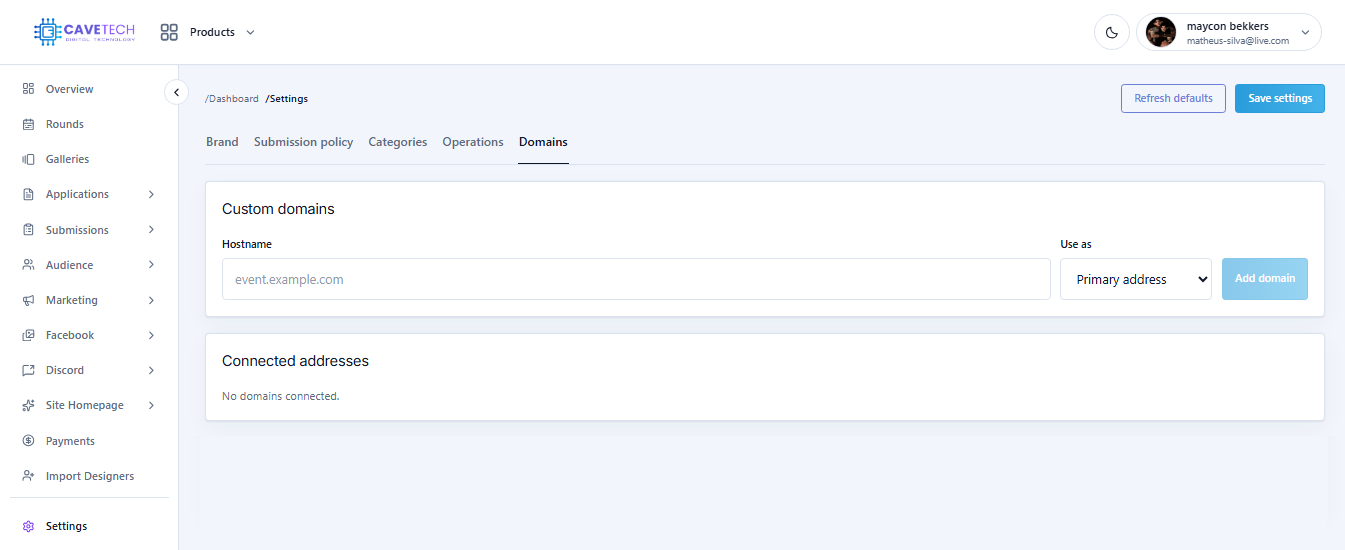
Adding a custom address
Hostname
Enter only the hostname, without https://, a path, or a trailing page name.
Examples:
event.example.comevents.example.compageplus.com.br
Subdomains are usually the safest option because they do not replace an existing website on the root domain. Root domains are supported only when your DNS provider supports the required alias, ANAME, or CNAME-flattening behavior.
Use as
Choose how the hostname behaves:
- Primary address — the public address displayed as the main event URL;
- Redirect alias — an additional active address that redirects or aliases to the primary event address.
Only an active redirect alias can later be promoted to primary.
Add domain
Select Add domain to register the hostname with EventSale. The domain card then displays the DNS records that must be created at the domain provider.
If you add a root domain that already has a website, EventSale asks you to confirm that the DNS change may replace the current website. This confirmation is a safety step; it does not change your registrar or DNS automatically.
DNS records
The domain card displays every record required for that hostname in four clearly labeled columns:
- Type — such as CNAME, TXT, or another record type;
- Name / Host — the exact DNS record name to enter at your provider;
- Value / Target — the exact destination or verification token; and
- Copy — copies the value so you can paste it without typing errors.
Create each record at the DNS provider that manages the domain. The names and values must be copied exactly as displayed. Do not add https:// to a DNS value and do not replace a CNAME with an A record unless the instructions explicitly say so.
The provider may show fields with different names, such as Name, Host, Target, or Points to. Use the labels in EventSale to map the values into the equivalent fields at your provider.
Checking a domain
Check now
After publishing the DNS records, select Check now on the domain card. EventSale refreshes the provider and DNS status and may continue certificate issuance when the required records are visible.
DNS changes can take time to propagate. A successful button message means the check ran; it does not necessarily mean the certificate is already active.
Last checked
This timestamp shows when EventSale last refreshed the domain status. If it says Not checked yet, use Check now after the DNS records are published.
Certificate status
The certificate line reports whether HTTPS certificate issuance is pending or active. The hostname may remain unavailable over HTTPS while DNS validation or certificate issuance is still pending.
Connected address cards
Each connected hostname displays:
- the hostname;
- its status, such as active, degraded, error, or pending;
- whether it is the Primary address or a Redirect alias;
- the last check time;
- the next action required;
- the DNS records to publish;
- the certificate status; and
- the CaveTech fallback link while the custom address is being prepared.
Make primary
This action is available for an active redirect alias. It changes which connected hostname EventSale treats as the main public event address.
Remove
Select Remove to disconnect a custom hostname. For safety, EventSale asks you to type the complete hostname before confirming. Removing the custom address does not delete the event or its public content; the CaveTech fallback remains available.
Safe setup sequence
- Add a subdomain when possible.
- Choose Primary address or Redirect alias.
- Copy each DNS record exactly as shown.
- Wait for the provider to publish the records.
- Select Check now.
- Wait until the certificate is active before sharing the custom HTTPS address.
If the domain remains pending, confirm that the DNS provider is authoritative for the domain, that there are no conflicting records, and that every displayed verification record is present.